
EMS engineering | Pharma, biotech & laboratories
Build, extend or upgrade your EMS
Engineering studies, advisory and integration for environmental monitoring systems.
MAJ Solutions supports you as you design and evolve your installations: technical architecture, instrumentation, electrical cabinets, interfaces with existing systems, documentation and support for validation or qualification.
A targeted assignment or support across several phases, depending on what your project needs.
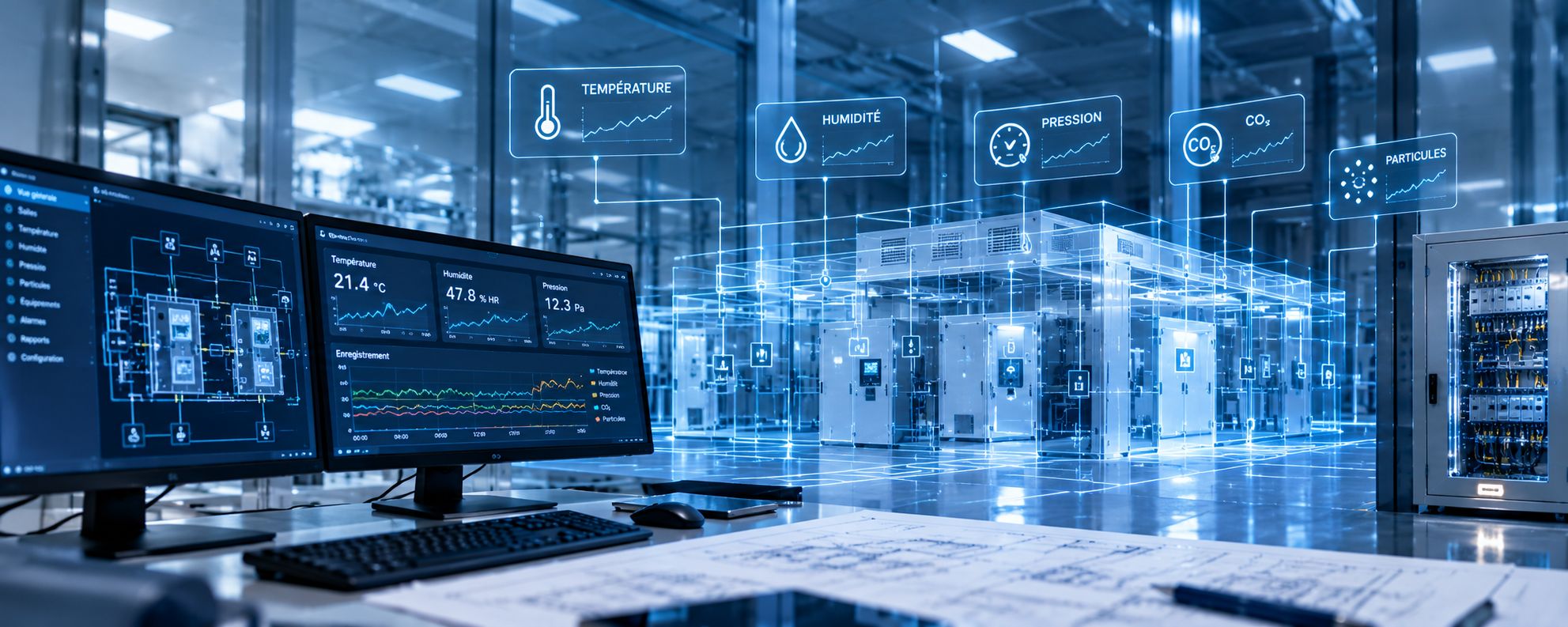
Your EMS project
Where does your EMS project stand?
MAJ Solutions works at different stages of the life cycle of an environmental monitoring system, from defining the requirements to upgrading existing installations.
New installation or EMS replacement
You are preparing a new system or replacing an existing one: defining requirements, writing the URS, technical architecture and supplier consultation.
Extending a system in operation
You are adding sensors, equipment or monitored areas, with an assessment of the technical, documentation and qualification impacts under change control.
Reviewing and upgrading an existing EMS
You want to improve alarm management, data use, interfaces or documentation, while taking data integrity requirements into account.
Project management and on-site deployment
You need to coordinate suppliers, electrical works, technical integration, testing and commissioning, or to reinforce your project teams on a temporary basis.
Our services
Support tailored to every phase of your EMS project
From technical study to qualification, our services can be engaged individually or combined, depending on what your project needs.
Requirements analysis and URS
Identifying critical parameters, defining user and functional requirements, writing or revising user requirement specifications (URS).
Architecture and technical choices
Defining the EMS architecture, selecting instrumentation, positioning measurement points and studying interfaces with existing systems (BMS, SCADA, PLCs).
Alarms, data and operation
Defining or reviewing thresholds, alarms, notifications and histories. Taking traceability, data integrity and trend analysis requirements into account.
Instrumentation and field integration
Selecting and supplying equipment, designing electrical cabinets and enclosures, cabling, connection, technical integration and commissioning support.
Validation, qualification and documentation
Risk assessments, validation strategy, preparing and executing FAT/SAT tests and IQ/OQ, traceability matrices and quality documentation.
EMS project management
Technical management of your project
Planning, coordination of suppliers and contractors, activity tracking, management of technical interfaces and support through to commissioning.
Example deliverables
Services and deliverables defined according to the scope of each assignment.
EMS & thermal mapping
Monitor continuously, characterise as needed
Environmental monitoring (EMS)
Long-term monitoring of critical parameters: temperature, humidity, differential pressure, oxygen, particle counting or other measurements depending on the installation.
Detect drift, manage alarms and ensure the traceability of environmental conditions.
Thermal mapping
A measurement campaign that characterises how temperature is distributed in a piece of equipment or an area, and identifies hot spots, cold spots and temperature variations.
Assess thermal performance and help choose the locations for permanent monitoring.
Two complementary approaches
Mapping results can guide where permanent monitoring probes are positioned, taking critical areas and operating conditions into account.
Regulated environments
In GxP environments, our work takes the applicable requirements into account, including EU GMP Annexes 1 and 11, GAMP 5 good practice and, where relevant, 21 CFR Part 11.
The approach is adapted to the system’s intended use, the criticality of the data and the risks identified.
Let’s talk about your project
An EMS project to define, deploy or upgrade?
Tell us about your situation: type of installation, project stage and main constraints. We discuss it with you to identify your needs and define the right support, from a targeted assignment to a broader project.
Describe your EMS project